Dasavatharam - Madhubani
Author: Mathu / Labels: MadhubaniPattachitra
Author: Mathu / Labels: patachitraKangra Painting - Annapoorani Amman
Author: Mathu / Labels: Kangra
India's rich painting heritage encapsulates diversified shades in the world of paitings.The Kangra Miniatures of the Pahari School is also an integral part of Traditional Indian Paintings.This art form made a mark in the 18th century. Kangra School of miniature paintings was influenced by the Mughal Miniature style of painting, though it successfully retained its distinctiveness.
These ethnic indian paintings were naturalistic and employed cool, fresh colors. The colors were primarily extracted from minerals, vegetables and possessed enamel-like luster.Ever enticing greenery of the landscape, brooks, springs were the recurrent images on the miniatures.Painters explored endless themes for their paintings from the texts of the Gita Govinda, Bhiari's Satsai, and the Baramasa of Keshavdas. Similarily the eternal love of Krishna and Radha rejoicing the moments of love was also portrayed very frequently.
The paintings based on Ragmalas (musical nates) also found patronage in Kangra school. Some of the famous Kangra Ragmala Paintings include Ragini Gujari, Raga Lalit and Ragini Sorathi.
A distinct aspect of kangra School of painting adopted in later course was that it included the scenes under star-studded skies and also portrayed storms with lightning running across the horizon. This feature was not found in any other style of painting . Kangra miniatures also depicted towns and cluster of houses in the distance iagain in later periods.Although mountains above the height of 13,000 ft were never made a part of the paintings.
Kalamkari [Lord Shiva]
Author: Mathu / Labels: Kalamkari
Kalamkari is an exquisite ancient craft of painted and printed fabrics. It derives its name from "Kalam" meaning Pen, and "Kari" meaning work, literally Pen-work. It is hand painting as well as block printing with vegetable dyes.
Very old, this art knew it's apogee in the rich person kingdom of Golconde [ the current city of Hyderabad,Andra Pradesh]. It has evolved through trial and error over the last 3000 years. Techniques of craftsmanship in Kalamkari were handed down within the families from generation to generation.
In Andra Pradesh, both the Masulipatnam and Srikalahasti villages are recognised as major centres for Kalamkari painting. Thus came the two styles of Kalamkari painting - Masulipatnam style ans Srikalahasti style.
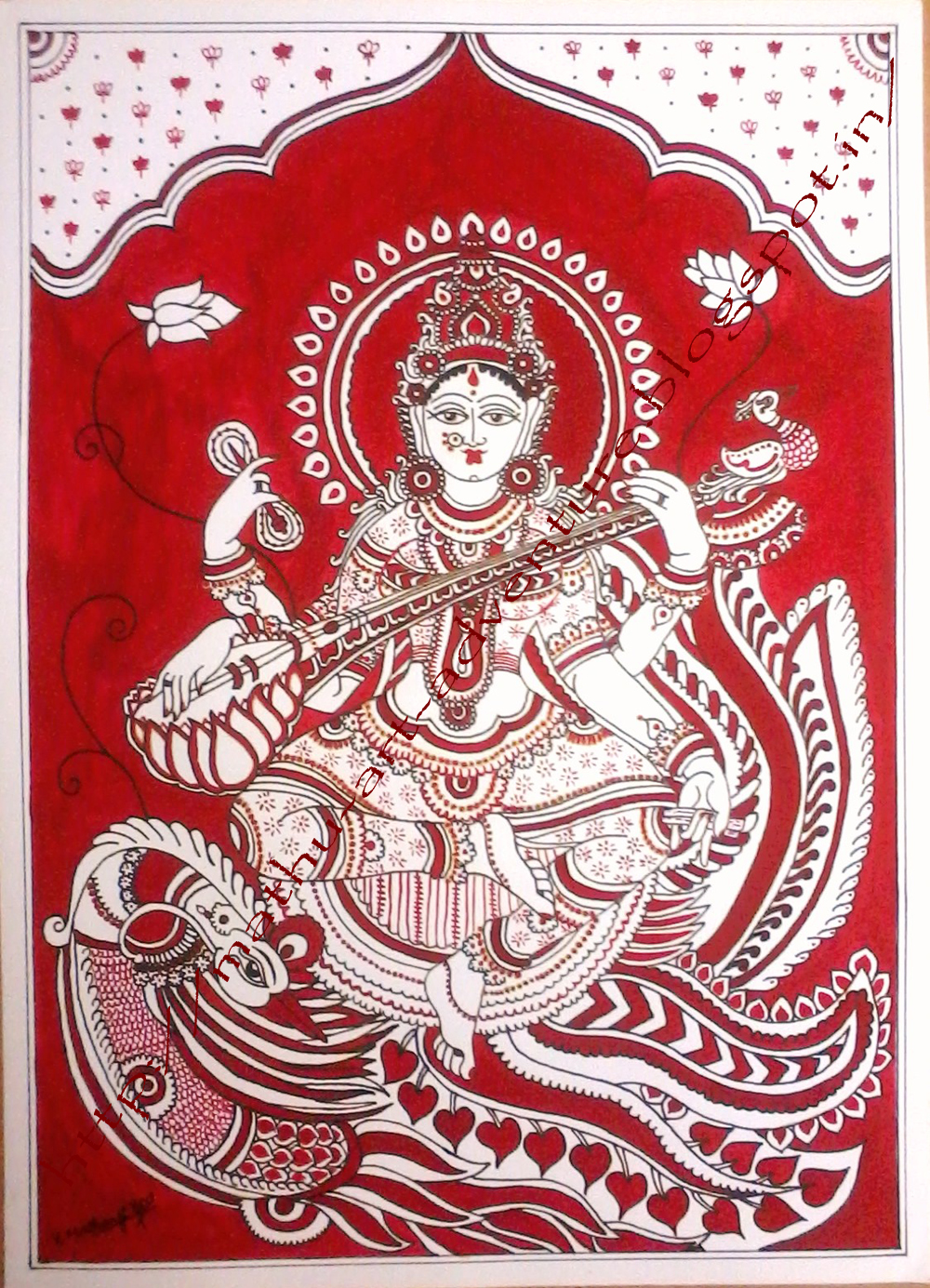
Kalighat painting [Saraswathi]
Author: Mathu / Labels: Kalighat painting
Kalighat painting derives its name from its place of originKalighat, in Kolkata - the erstwhile capital of British India. This painting form has its roots in the cultural upheavals of nineteenth century colonial Bengal. At this time a huge number of village folk had migrated from rural Bengal and settled in and around the famous Kalighat temple. Amongst them, many were potters and scroll painters. These were the people whose painting style and themes later came to be known as Kalighat painting. They used watercolors and painted on inexpensive mill papers.
Brushes were made from squirrel and calf hair. Cheap color pigments were applied in transparent tones, which was totally different from the traditional of Indian tempera. With shaded contours and articulated gesture and movement, the figures attained a plaque-like effect on a neutral unpainted ground. The style is characterized by formal and linear economy, meaningful gestures, and quality brushwork and flawless rhythmic strokes. The drawings are bold and attractive and at the same time their technique is different and simple.
Lakshmi Puja Alpona Pattern
Author: Mathu / Labels: RangoliDakshinamurthy - Kerala Mural
Author: Mathu / Labels: Kerala MuralSaura Painting [Orissa]
Author: Mathu / Labels: Saura
This folk art painting is known as ‘Saura painting’. The ‘Saura’ tribe of Orissa makes these paintings. The theme of this folk painting has been drawn from their everyday life, showing several rows of human forms engaged in daily or ceremonial activities. In alternating set of rows, differing moods of dancing and warring people are portrayed. Seated on horses or elephants, men go on wars to protect the natural rhythm of life back home. At the base of the painting, we see men around a tree, signifying the close connection between man and nature.
Pithora Painting
Author: Mathu / Labels: pithora
Pithora Paintings are much more than colorful images on walls for the tribes of Rathwas, Bhilals, and Naykas of Gujarat and Madhya Pradesh . They signify the advent of an auspicious occasion (like weddings, childbirth, festivals) in the family or community. An art form, which essentially conveys the joy and celebration of a community, has to reflect the collective mood of it, and Pithora paintings with their colors and animated figures mirrors the sentiments of their creators.
The essence of a Pithora painting lies in its earthiness; everything from the theme to the execution has the ethnicity of rural India. Even materials used are quite exotic: the colors are prepared by mixing pigments with milk and liquor prepared from the auspicious Mahuda tree. Indeed the joie de vivre of the community couldn't have found a more suitable mean of expression.
The tribes
The tribes of Rathwas , Bhils and Nayaks of central Gujarat and Madhya Pradesh practice this Art form.
The Rathwas have a distinct cultural heritage and an interesting historical background. They mimic the upper caste of Tadagis in their way of life. They depend on the forests around them for a livelihood. The forests therefore are sacred for them. The family is the most important unit of this tribe and they practice arranged marriages, however clan exogamy is also observed. Their intrinsic aesthetics is evident in their quaintly done mud hits, which are adorned with colorful Pithora Paintings.
The ancient tribes of Bhils too practice this art form with meticulous diligence.
The Ritual called Pithora Paintings
Pithora Painting can be called a ritual rather that an art form for it is “performed” to thank God or for a wish or a boon to be granted. A comprehensive understanding of this ritual will call for a narrative- the head priest of the community who is called “Badwa”, is summoned when a problem occurs in a family. The problems are narrated to the Badwa “ who offers solutions, which almost always involves the painting of Pithoras on the walls of the house. The Pithora Baba is considered to be the reigning deity of the community and his presence is considered to be the solution of all problems. The first wall of the house is considered to be the right place for a Pithora. A Pithora is however, considered to be a three-wall affair, so the first wall and the other two walls around it are prepared for the painting. The walls to be painted are first plastered with mud and cow dung by the unmarried girls of the household, and then coated with chalk powder this process is called lipna. And then the painters proceed to do their work.
Kerala Mural
Author: Mathu / Labels: Kerala Mural
Kerala mural paintings are the frescos depicting mythology and legends, which are drawn on the walls of temples and churches in South India, principally in Kerala. Ancient temples, churches and palaces in Kerala, South India, display an abounding tradition of mural paintings mostly dating back between the 9th to 12th centuries CE when this form of art enjoyed Royal patronage.
Patachitra
Author: Mathu / Labels: patachitra
The word patachitra is derived from the Sanskrit word "pata", which means a painted piece of cloth, a picture, a tablet or a plate; "chitra" means painting or picture. Elements of folk and sophisticated art and craft characterise each finely executed patachitra. It is the traditional art of ORISSA. The intricate picture is drawn using vegetable colours on a special fabric (matha). This fabric is stuck to a wooden base using glue(kaitha atha).
Phad Painting [Rajasthan]
Author: Mathu / Labels: phad
Phad painting is a beautiful specimen of Indian cloth painting. Rajasthan in Western India is its place of origin. In the simplest term Phad can be described as a large painting on cloth, which venerates the deeds of a hero. The smaller version of phada is known as phadakye. Generally, the life events of Goga Chauhan, Prithaviraj Chauhan, Amar Singh Rathor, Tejaji, and many others were illustrated on the Phadas in the earlier times but today the stories from the life of Papuji, and Narayandevji are primarily depicted. For their unique beauty and chronicling character, Phada painting has come to be regarded as one of the most sought after folk paintings in the world.
I have done the above painting on handmade paper using poster colors.
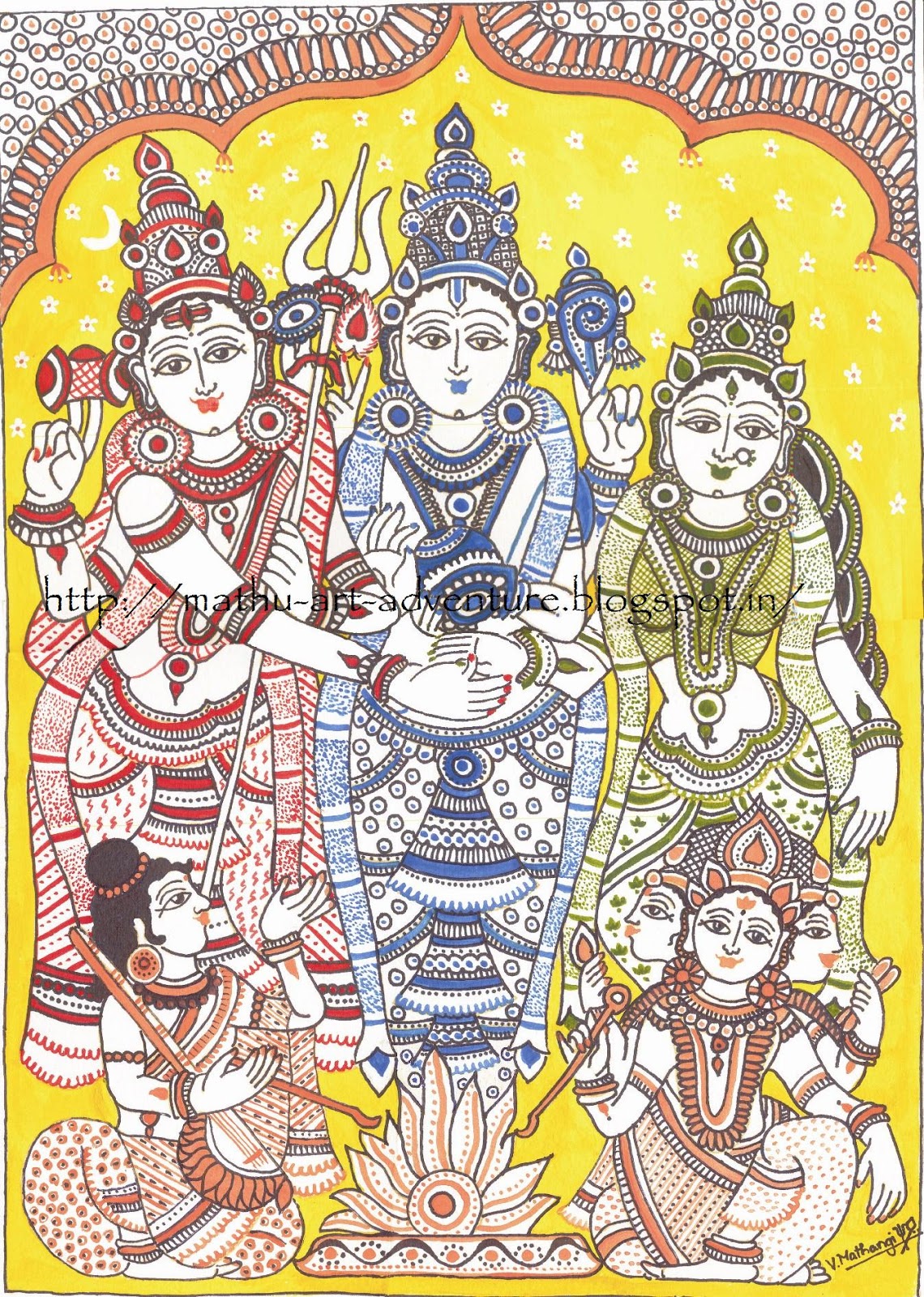
Madhubani - Latest - Ardhanareeshwarar
Author: Mathu / Labels: MadhubaniGond Painting
Author: Mathu / Labels: GondI did the above two paintings, of which the first is known as "Tree of life". I have used ceramic colors on hand made paper.


Warli painting, one of the most intriguing forms of Indian folk paintings, is a gift from a small tribe of the same name living in Maharashtra, India. Executed in white on austere mud walls, these tribal paintings are spontaneous expressions of folk life, customs and beliefs.
The scenes depicted in a warli painting can broadly be classified into three as follows:
1. Village scene [Tribe's daily routine is shown on the red]
2. Marriage Procession [on the green]
3. Taarpa Dance


Centuries old, this art is done mainly by the females of the family, and is a part of the daily ritual. It is believed that every morning the gods come invisibly to the household to bless the members of the family and to bring more prosperity. So this art started as a daily welcome painting for the Gods by decorating the outside of the house, the walls or the floor.
The walls and floors of the house were coated with cow dung and mud paste. When it dried it gave a perfect dark background to the bright paintings done with white rice paste. The diluted cow dung is also a natural antiseptic which is why it is valued as a floor and wall covering anyway - regardless of whether any one was going to paint on it!
There are three types of Madhubani painting.
1.Brahmin Style
2.Tatoo Style
3.Kshatriya Style
I have painted one in each style using Indian ink with the help of a nib pen.[scroll up to see my paintings. Brahmin style - Krishna; Tatoo style - design in concentric circles; Kshtriya style - three Suns].